
Understanding the Difference and Why It Matters
When facilities begin evaluating Legionella testing options, choosing between PCR and culture testing is not simply a laboratory decision. The testing method can directly influence how facilities interpret risk, respond to findings, and demonstrate control during audits, investigations, or remediation efforts.
PCR and culture are fundamentally different Legionella water testing methods that evaluate different aspects of a building water system and serve different purposes within a water management program. Understanding those differences is important because the selected testing method can directly impact how results are interpreted, how corrective actions are approached, and whether findings align with regulatory or industry expectations.
Why the Testing Method Matters
Legionella testing is not simply about receiving a positive or negative result. The method used determines what is being detected within the sample and how actionable that information may be.
In healthcare and high-risk building environments, that distinction becomes especially important. Facilities are often making operational, compliance, and remediation decisions based on those findings. Using the appropriate method helps ensure the response is informed, defensible, and aligned with the facility’s goals.
Why Facilities Get Confused
Part of the confusion comes from the fact that PCR and culture testing are often discussed as competing methods. They answer different questions about the water system. A rapid result does not always provide the same operational insight as a viability-based result, and a slower method does not necessarily mean it provides less value.
Understanding what each method is measuring is what allows facilities to interpret results more accurately and make better-informed decisions within their water management program.
What Is Culture Testing?
Legionella culture testing is considered the gold standard and widely recognized method for detecting Legionella in water systems. The process involves growing viable Legionella organisms on selective media under controlled laboratory conditions.
Because the method requires living organisms to grow, culture testing identifies viable bacteria capable of reproduction under laboratory conditions. Results are typically reported as colony-forming units (CFU), which provide facilities with a quantifiable measure of contamination.
Culture testing is widely referenced in industry guidance and standards because it helps determine whether viable Legionella organisms are present within the system. It also allows laboratories to isolate organisms for further identification and comparison when needed during investigations or outbreak response.
However, culture testing does require longer turnaround times, seven to fourteen days, because organisms must be given time to grow and confirm.
What Is PCR Testing?
PCR (Polymerase Chain Reaction) testing is a molecular testing method that detects the presence of Legionella DNA within a water sample. Unlike culture testing, PCR does not rely on growing organisms under laboratory conditions.
One of the primary advantages of PCR testing is its speed. Results are often available much faster than traditional culture methods, takes between 24-48 hours which can make PCR useful in situations where facilities are seeking more rapid visibility into potential system conditions.
However, PCR findings may require additional interpretation depending on the context of the Legionella sampling event and the facility’s operational history.
A PCR-positive result does not always indicate active amplification of viable Legionella organisms within the system. In some cases, facilities may be detecting residual genetic material following remediation, disinfection activities, or the presence of non-viable organisms.
Because PCR and culture testing measure different things, understanding how results should be interpreted operationally is an important part of selecting the appropriate testing approach.
PCR vs. Culture: The Key Difference
That difference directly affects how results should be interpreted operationally.
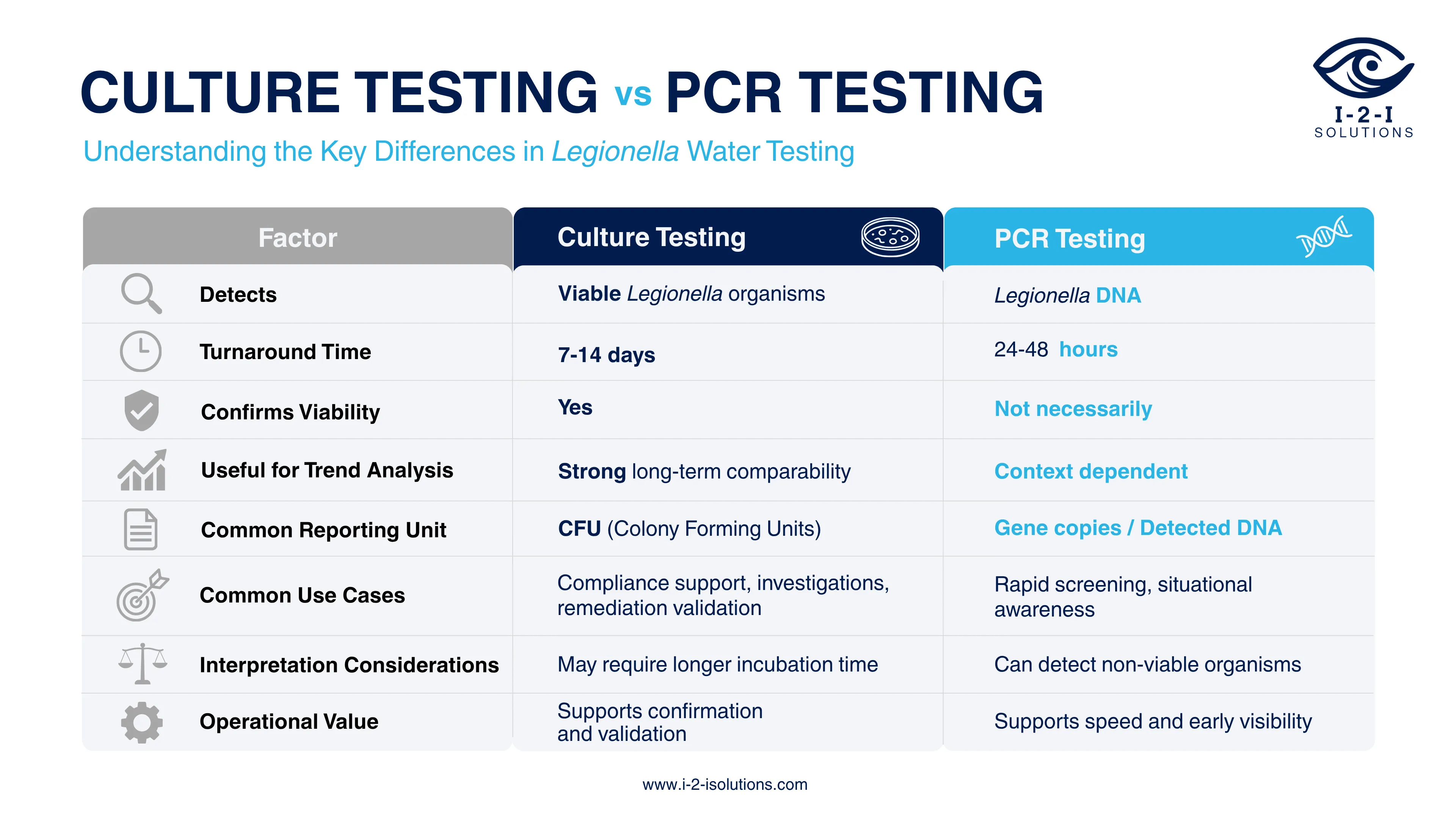
Side-by-side comparison of PCR and culture testing
The most important distinction between PCR and culture testing is what each method detects.
- Culture testing identifies viable Legionella organisms capable of growth under laboratory conditions.
- PCR testing identifies Legionella genetic material (DNA) within a water sample.
That distinction directly affects how results are interpreted operationally.
PCR testing is often valued for its speed and rapid screening capabilities, with results commonly available within 24–48 hours after sample receipt. This can help facilities gain earlier visibility into potential system concerns.
Culture testing, while slower with turnaround times typically ranging from 7–14 days, remains widely recognized as the referenced “gold standard” by the Centers for Disease Control and Prevention (CDC), because it focuses on viable organisms capable of growth under laboratory conditions.
For many healthcare and compliance-driven environments, culture-based findings are often considered more actionable for remediation decisions, trend analysis, outbreak investigations, and regulatory documentation.
In some water management programs, facilities may use PCR for rapid initial screening and follow positive findings with culture confirmation to support remediation and compliance decisions.
Why Culture Testing Is Still Widely Referenced
Culture testing continues to play a central role across healthcare water management programs, industry guidance, and outbreak investigations.
Organizations and frameworks such as ASHRAE 188, CDC guidance, and many healthcare facilities have historically centered around culture-based interpretation and viability-focused response strategies.
Because culture methods focus on viable organisms, they are often used in situations where facilities require more defensible documentation during remediation efforts, audits, investigations, or regulatory review.
That does not mean PCR lacks value. Rapid molecular detection can support faster visibility and broader monitoring efforts, particularly when facilities are seeking earlier insight into changing system conditions.
Rather than competing methods, PCR and culture testing often serve complementary roles within a broader water management strategy.
Choosing the Right Approach
The “right” testing method depends on the facility’s objectives, the level of risk involved, and how the results will be used operationally.
For some facilities, rapid screening may support broader monitoring efforts or help identify trends more quickly. In other situations, facilities may require viability-based results to support remediation decisions, regulatory expectations, or long-term program validation.
PCR and culture testing are not interchangeable methods. They provide different types of information and should be interpreted within the context of the facility’s water management strategy.
Understanding those differences helps facilities avoid misinterpretation, unnecessary response actions, or a false sense of security.
The Bigger Picture
As Legionella risk management continues evolving across healthcare and high-risk facilities, understanding testing methodologies becomes increasingly important.
Facilities are under growing pressure to demonstrate that their water management programs are not only active, but also technically defensible. That includes understanding the strengths, limitations, and intended use of the methods supporting those programs.
Facilities should work with laboratories that can clearly explain testing methodologies, reporting limitations, turnaround expectations, and how results should be interpreted within the context of a broader water management program.
When patient safety, compliance exposure, and operational decisions depend on testing data, understanding the methodology behind that data becomes critical.
Understanding the method is just as important as receiving the result.
Explore more Legionella water management insights in the I-2-I Solutions Knowledge Hub, or schedule a free consultation with our team today to discuss the right approach for your facility.