
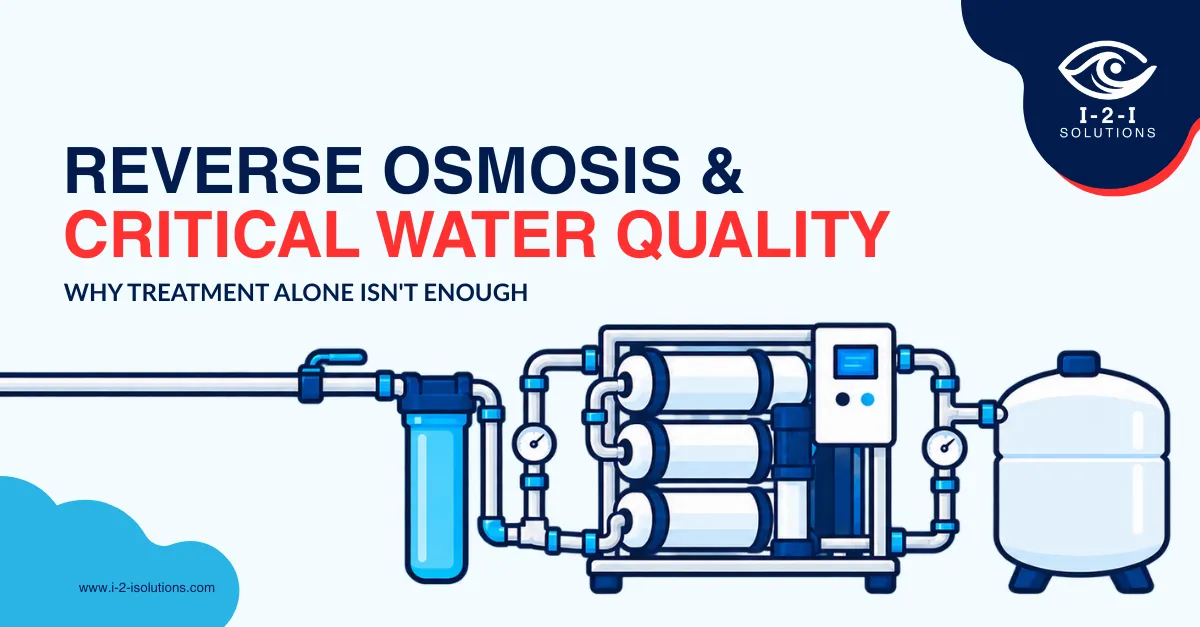
Reverse osmosis (RO) systems play an important role in healthcare water treatment, particularly in sterile processing departments where consistent water quality is essential.
But having an RO system raises an important question:
Why do we still need to test if our water is already treated?
While reverse osmosis reduces dissolved minerals and other contaminants, treatment alone does not guarantee that water consistently meets the specifications required for medical device processing.
Understanding what RO systems accomplish, where water-quality problems can develop, and why routine testing remains necessary helps facilities maintain reliable Critical Water systems.
Critical Water Quality Is Important in Sterile Processing
Water is used throughout medical device reprocessing, from cleaning and washing to final rinsing. Its quality can affect instrument condition, equipment performance, and patient safety.
ANSI/AAMI ST108:2023 establishes a framework for managing water quality in medical device processing, distinguishing between Utility Water, Critical Water, and Steam.
Critical Water is treated water used in applications requiring higher water quality, including final rinsing. Controlling its chemical and microbiological characteristics is particularly important because water may contact medical devices during later processing stages.
How Reverse Osmosis Supports Critical Water Quality
Reverse osmosis uses pressure to move water through a semipermeable membrane, reducing dissolved minerals, salts, and many other contaminants.
In sterile processing, RO treatment helps limit impurities that may contribute to scaling, instrument staining, corrosion, or equipment problems.
Depending on the system design, RO may be combined with filtration, deionization, or other treatment technologies to achieve the required water quality.
However, reverse osmosis is not sterilization. Although RO membranes can remove many microorganisms and endotoxins, having an RO system does not automatically establish that the final water supply meets every Critical Water specification.
How Water Quality Can Change After Treatment
Even when an RO system operates as intended, water quality can change because of conditions within the treatment and distribution system.
Common factors include:
- Membrane performance: Fouling, scaling, or membrane damage can reduce treatment efficiency.
- Storage and distribution: Tanks, piping, and low-flow areas may contribute to microbial contamination or biofilm development.
- Incoming water quality: Changes in source-water characteristics can affect treatment performance and maintenance needs.
As a result, water leaving the RO system may differ from water delivered to sterile processing equipment.
This is why monitoring should consider the entire water system, not just the treatment equipment.
Why Routine Reverse Osmosis Water Testing Is Necessary
RO systems commonly use conductivity measurements to monitor dissolved ionic contaminants and treatment performance.
However, acceptable conductivity does not confirm acceptable microbial counts or endotoxin levels.
Routine laboratory testing helps facilities evaluate whether treated water meets the applicable ANSI/AAMI ST108 specifications.
Depending on the water category and application, important parameters may include conductivity, pH, hardness, chemical contaminants, heterotrophic plate count (HPC), and bacterial endotoxin.
Sampling location matters, too. Testing at treatment outlets, distribution points, and points of use can help identify where water quality may be changing.
Using Testing Results to Support Water Quality Management
Routine testing does more than provide a pass-or-fail result.
When reviewed over time, laboratory data can help identify changes in treatment performance, microbial conditions, or water chemistry.
Testing can also support verification following maintenance, system repairs, or corrective actions.
Combining laboratory results with operational measurements and maintenance records allows healthcare teams to better evaluate system conditions and make informed decisions.
How I-2-I Solutions Supports Critical Water Testing
I-2-I Solutions supports healthcare facilities and sterile processing departments through professional water sampling, coordinated laboratory testing, and water-quality reporting.
Our services help facilities monitor Utility Water, Critical Water, and Steam in alignment with applicable ANSI/AAMI ST108 guidance.
Through appropriate sampling and chemical and microbiological testing, we provide data that supports routine monitoring, investigations, and follow-up verification.
Treatment and Testing Work Together
Reverse osmosis plays an important role in producing high-quality water, but its effectiveness depends on proper maintenance, system oversight, and ongoing verification.
An RO system treats the water. Testing helps verify that its quality meets the requirements of its intended use.
For sterile processing departments, both are essential parts of maintaining a reliable Critical Water program.
References
- Association for the Advancement of Medical Instrumentation (AAMI). ANSI/AAMI ST108:2023 - Water for the Processing of Medical Devices.
- American National Standards Institute (ANSI). ANSI/AAMI ST108:2023 - Water for Processing Medical Devices.
- Centers for Disease Control and Prevention (CDC). Guidance for Healthcare Water System Repair and Recovery Following a Boil Water Alert or Disruption of Water Supply.
- Centers for Disease Control and Prevention (CDC). Water - Guidelines for Environmental Infection Control in Health-Care Facilities.