
SPS and Critical Water Testing
Support safer sterile processing with routine Utility Water, Critical Water, and steam-quality testing aligned with ANSI/AAMI ST108 guidelines.
I-2-I Solutions offers comprehensive Critical and Utility Water Testing trusted by federal agencies, healthcare facilities, and mission-critical environments
Water Quality Matters at Every Stage of Sterile Processing
Water is used throughout the cleaning, rinsing, disinfection, and sterilization of reusable medical devices. Its quality can affect cleaning effectiveness, instrument condition, equipment performance, microbial control, and the reliability of sterile processing operations.
ANSI/AAMI ST108 provides a framework for managing the quality of water and steam used to process reusable medical devices. It identifies three principal water categories:
Utility Water
Utility Water is generally used for flushing, washing, and initial cleaning. Routine monitoring can help identify conditions that contribute to scaling, corrosion, staining, ineffective cleaning, microbial growth, or damage to processing equipment.
Critical Water
Critical Water is treated water used for applications requiring a higher level of quality, including final rinsing and certain reprocessing activities. Chemical purity, microbial quality, and endotoxin control are important because this water may contact devices during the final stages of processing.
Steam
Steam used for sterilization can carry contaminants from the water supply or steam-generation system. Monitoring helps facilities identify conditions that may contribute to staining, deposits, corrosion, wet packs, equipment problems, or inconsistent sterilization performance.
Why Routine SPS Water Testing Is Important
Water quality can change even when the treatment system appears to be operating normally. Filters and treatment components age, maintenance activities affect system conditions, biofilm can develop, and changes in the incoming water supply may influence system performance.
Routine testing gives sterile processing and facility teams the information needed to:
- Verify that Utility Water, Critical Water, and Steam systems remain suitable for their intended uses
- Identify chemical or microbiological changes before they become larger operational problems
- Evaluate the performance of reverse osmosis, deionization, softening, filtration, and other treatment processes
- Recognize trends involving conductivity, hardness, microbial counts, endotoxin, or organic contamination
- Support investigations involving instrument staining, scaling, corrosion, residue, or equipment performance
- Document monitoring activities and corrective actions, and maintain reliable records
One acceptable result only reflects conditions at a particular place and time. An effective monitoring program uses routine measurements, laboratory results, and trend reviews to demonstrate that water quality remains controlled over time.
When Should SPS Water Systems Be Tested?
Testing schedules should reflect the water category, intended use, treatment-system design, equipment manufacturer instructions, historical performance, and your facility’s risk assessment.
Routine Monitoring
Scheduled field measurements and laboratory testing used to verify ongoing system performance and identify developing trends.
System Qualification
Testing performed when qualifying a new or substantially modified water treatment or distribution system.
After Maintenance or Repairs
Verification following filter changes, membrane replacement, system disinfection, repairs, or other work that may affect water quality.
After an Out-of-Specification Result
Follow-up testing used to investigate the condition, evaluate corrective action, and verify that acceptable water quality has been restored.
When Operational Problems Occur
Targeted testing to help investigate staining, scaling, corrosion, unusual residues, wet packs, elevated microbial results, or changes in equipment performance.
A Complete SPS Water Testing Solution
Plan
We review your sterile processing applications, water-treatment system, sampling locations, existing results, and monitoring requirements. From there, we help establish a testing approach appropriate for your Utility Water, Critical Water, and Steam systems.
Sample & Test
Our team can collect samples, document site conditions, measure time-sensitive field parameters such as pH, temperature, and conductivity, and coordinate chemical and microbiological laboratory analysis.
Report & Monitor
You receive organized, quality-reviewed results supported by clear sampling documentation and chain-of-custody records. We help your team understand findings, recognize trends, and identify results that may require investigation or corrective action.
SPS Water Quality Testing Capabilities
Critical and Utility Water Testing can be tailored to the type of water, intended application, facility monitoring plan, and applicable ANSI/AAMI ST108 guidance.
+ Ionic
Contaminants
Chemical and Physical Water-Quality Parameters
pH, Conductivity, Total hardness, Chloride, Iron, Copper, Silica, Alkalinity, Total dissolved solids, Free chlorine, Total chlorine or chloramine.
These parameters can help identify scaling potential, corrosion risk, treatment-system performance, chemical carryover, disinfectant conditions, and changes in the incoming water supply.
Common Critical Water Tests include:
Total Organic Carbon
Total Organic Carbon testing measures organic contamination that may remain in treated water. Elevated results may indicate inadequate treatment, contamination within the system, or a change in treatment-system performance.
Heterotrophic Plate Count
Heterotrophic Plate Count testing estimates the concentration of culturable heterotrophic bacteria in a water sample. Routine HPC monitoring can help identify changes in microbial conditions and support evaluation of treatment and distribution-system control.
Bacterial Endotoxin
Limulus Amebocyte Lysate testing or Endotoxin testing detects bacterial endotoxins associated with gram-negative bacteria. Endotoxin monitoring is an important part of evaluating Critical Water used in higher-risk device-processing applications.
Sampling That Reflects Your Actual Water System
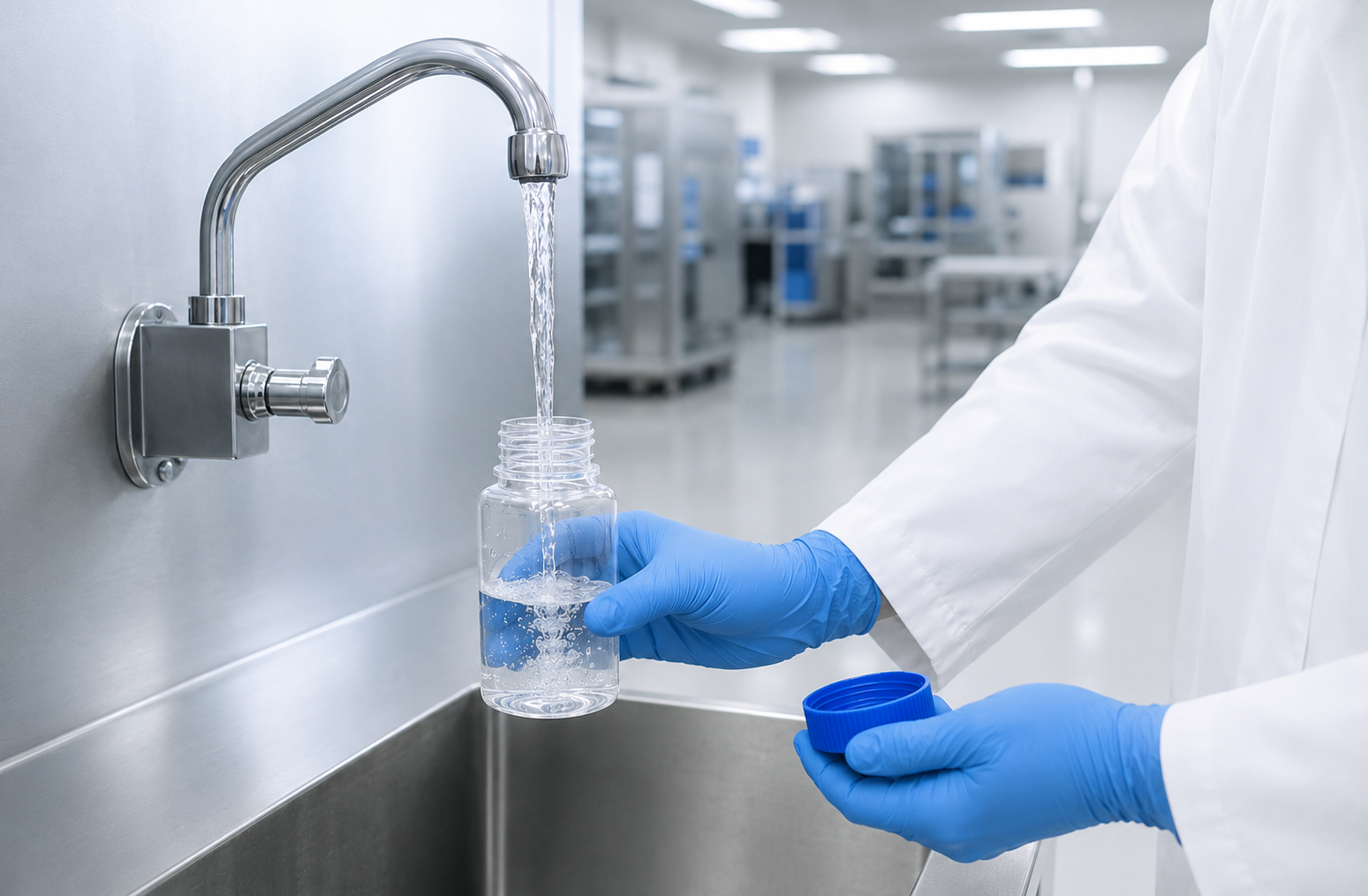
Reliable testing begins with appropriate sampling locations and collection practices. Depending on the facility and system design, sampling may include:
- Incoming Utility Water
- Water-treatment system influent and effluent
- Reverse-osmosis or deionization system outlets
- Critical Water generation points
- Storage tanks
- Distribution-loop return points
- Representative points of use
- Washer-disinfectors and other processing equipment
- Boiler-feed or steam-generation water
- Steam condensate, when included in the monitoring plan
Sampling from both generation points and representative points of use can help distinguish treatment-system performance from conditions developing within storage or distribution components.
Science-Led Testing with Federal-Grade Discipline
End-to-End Support
We coordinate the process from sampling planning and field measurements through laboratory analysis, reporting, and recurring monitoring.
Reliable Laboratory Data
Our laboratory quality systems and established analytical methods support accurate, traceable, and defensible results.
Field & Laboratory Integration
Time-sensitive parameters are measured on-site, with chemical and microbiological testing completed in the laboratory.
Clear, Actionable Reporting
Results are organized so all stakeholders can review findings and determine what happens next.
Ready to Strengthen Your SPS Water Quality Program?
Let’s build a testing approach around your facility and sterile processing operations.
Talk to an Expert →
Discover Our Latest Insights and Articles
Stay informed with our latest thinking on water quality management and compliance
Knowledge Hub →