
Legionella testing regulations vary by state, municipality, facility type, and water-system application. Some jurisdictions establish specific requirements for cooling towers, healthcare facilities, or outbreak response, while others rely more heavily on public-health guidance, building standards, and facility-specific risk management.
This 2026 guide explains how state and local requirements interact with CDC guidance, ASHRAE Standard 188, healthcare expectations, and Legionella testing practices, and what facility teams should verify when developing a defensible water management strategy.
Why This Matters More in 2026
Across the United States, Legionella requirements remain fragmented. A facility's responsibilities may arise from state or local regulations, healthcare requirements, accreditation frameworks, public-health protocols, and adopted industry standards. Therefore, the absence of a statewide testing mandate does not necessarily mean that a facility has no water management responsibilities.
The CDC identifies an effective water management program as the primary strategy for controlling Legionella growth and spread. It also recognizes routine Legionella testing as one method for validating whether a water management program is operating effectively. ASHRAE Standard 188 establishes minimum legionellosis risk-management requirements for applicable building water systems.
These frameworks can influence facility practices even where state regulations do not establish a universal testing schedule. This is particularly important in healthcare and other high-risk environments, where organizations may also be subject to facility-specific regulatory, licensing, or accreditation expectations.
Accountability extends beyond written mandates. Following a positive result, reported case, or outbreak, a facility may need to demonstrate how it assessed risk, monitored its systems, responded to findings, and documented corrective actions. In 2026, the practical question is not only whether Legionella testing is expressly required, but whether a facility can show that its water management program is appropriate, documented, and functioning as intended.
The Reality: Three Regulatory Categories Across States
To make sense of the landscape, it helps to think in three general categories:
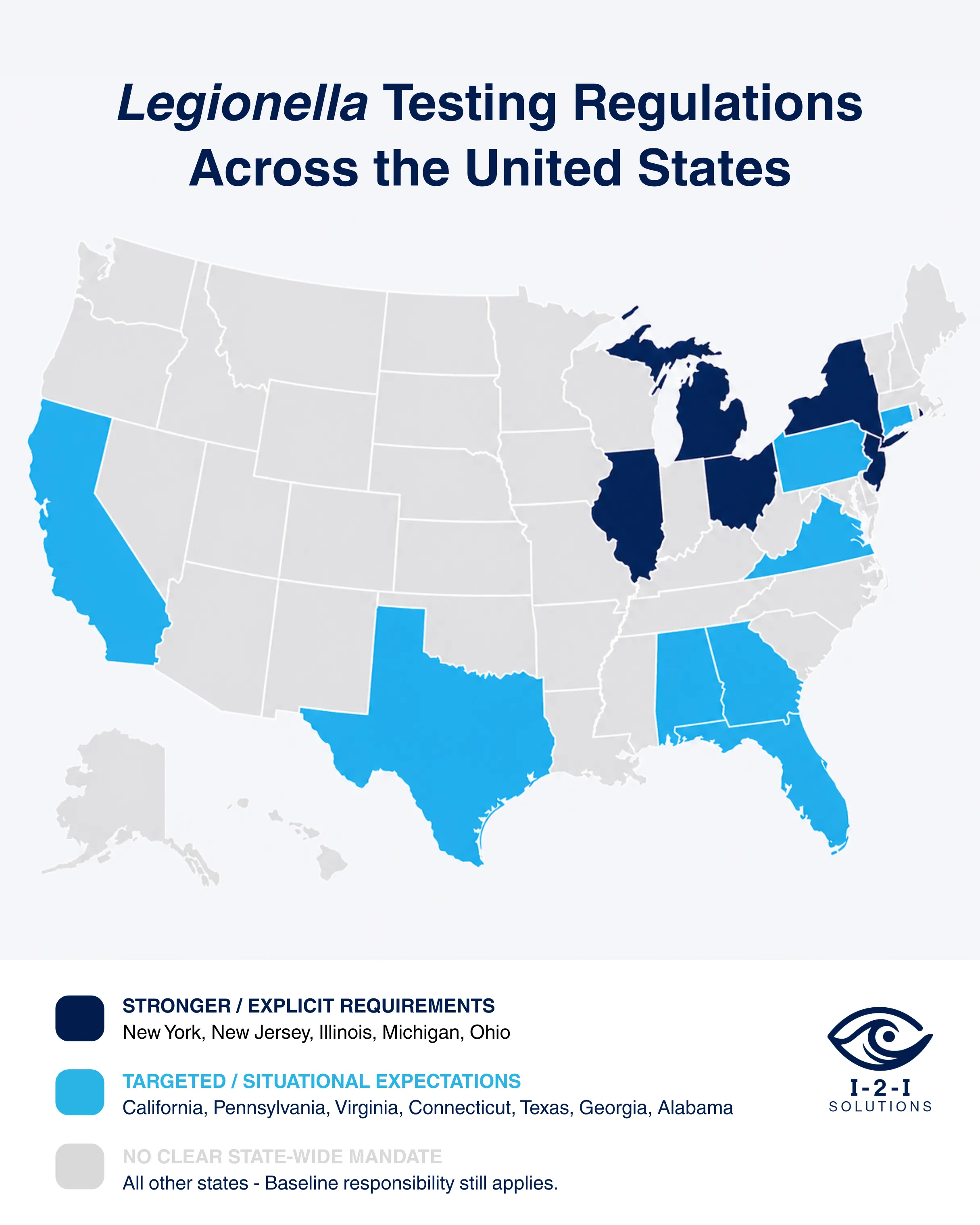
States with Explicit Legionella Regulations
Some states have established clear, enforceable requirements around Legionella risk ,sampling and testing expectations, and structured documentation and reporting. They often focus on higher-risk environments such as healthcare facilities and ones with cooling towers. States like New York and New Jersey are well-known examples. In these environments, compliance is clearly defined, regularly reviewed, and fully auditable.
States with Targeted or Situational Requirements
Other states take a more conditional approach. Instead of broad mandates, Legionella-related requirements are applied in specific situations ,during outbreak investigations, within certain facility types like hospitals or long-term care, or through local health departments and building codes. In states such as Illinois and Michigan, expectations are often tied to healthcare oversight and risk management practices rather than universal requirements. As a result, expectations may not be immediately visible until an issue arises or scrutiny is triggered, creating a more reactive compliance environment that can catch facilities off guard if programs are not already in place.
States with No Explicit Regulations
Many states still do not have formal, statewide Legionella testing mandates, which is where the biggest misunderstanding often occurs. States like Texas and Georgia, for example, may not have comprehensive statewide requirements, yet facilities are still expected to follow CMS-aligned water management practices, particularly in healthcare settings. At the same time, industry standards such as ASHRAE 188 continue to serve as the benchmark for risk management, regardless of location. Legal, operational, and reputational risks remain just as real ,which means that while the law may be silent, expectations and consequences are not
Explore Legionella and Water Management Guidance by State
Requirements, environmental conditions, and facility considerations differ across the country. Explore our growing collection of state-focused resources for practical information about Legionella testing, water management, monitoring, and building water systems.
The Gap Between "No Regulation" and Real Risk
This is the space where most facilities operate.
No clear mandate. No obvious enforcement.
But still:
- Patients, residents, and occupants at risk
- Internal accountability expectations
- Potential liability if something goes wrong
This is why many organizations are now shifting from asking:
"Are we required to test?"
to:
"Can we prove our system is under control?"
What Regulators and Surveyors Actually Look For
Regardless of state, high-performing programs tend to align around the same principles:
- A documented Water Management Program
- Defined control measures and limits
- Routine monitoring and verification
- Testing strategies that support decision-making
- Clear corrective action pathways
- Ongoing documentation and traceability
This is where guidance from organizations like the Centers for Disease Control and Prevention (CDC) and frameworks like ASHRAE 188 become critical.
They act as the de facto standard, even when regulations are unclear.
Instead of relying only on state mandates, facilities should focus on:
Why Safeguarding Occupants Is a Real Priority
Beyond regulations and compliance frameworks, this is ultimately about protecting the people who rely on your building every day.
Legionella risk doesn't exist on paper.
It exists in real environments, affecting real individuals:
- Patients with weakened immune systems
- Elderly residents in long-term care
- Staff and visitors exposed through routine water use
In high-risk environments ,especially healthcare ,the consequences are not theoretical. They can lead to serious illness, prolonged hospital stays, reputational damage, and in some cases, loss of life.
This is why water management programs are no longer viewed as just a compliance requirement. They are part of a facility's duty of care.
And this is where it becomes clear ,the question shifts from:
"Are we meeting the minimum requirement?"
To:
"Are we doing enough to protect the people in our care?"
Because at the end of the day, water safety is not just about systems ,it's about safeguarding occupants.
How I-2-I Solutions Supports Legionella Risk Mitigation
At I-2-I Solutions, we work with facilities across the United States to navigate this complexity with clarity.
Our approach is built around:
- Science-led Legionella testing aligned with ISO 11731:2017
- Participation in performance validation programs such as CDC ELITE
- Structured, transparent reporting that supports real-world decisions
In a fragmented regulatory environment, clarity matters more than ever.
What This Really Means
This isn't just about knowing your state's rules.
It comes down to this:
- Regulations are evolving
- Expectations are rising
- And responsibility doesn't stop at compliance
Want a Practical Breakdown for Your Facility?
If you're trying to understand how these expectations apply in real-world scenarios:
Read: "Is Legionella Testing Required in Alabama? The Practical Breakdown"