
Healthcare facilities often ask a straightforward question
How often should we test our water?
There is no universal answer that applies to every building. A hospital, long-term care facility, outpatient center, and specialty clinic may serve different patient populations and operate very different water systems. Building age, plumbing complexity, occupancy, water use, previous results, and the presence of aerosol-generating devices can all influence the appropriate approach.
For that reason, water-testing frequency should not be selected at random or based only on a calendar. It should be connected to the facility’s water management program and designed to answer specific questions about system performance.
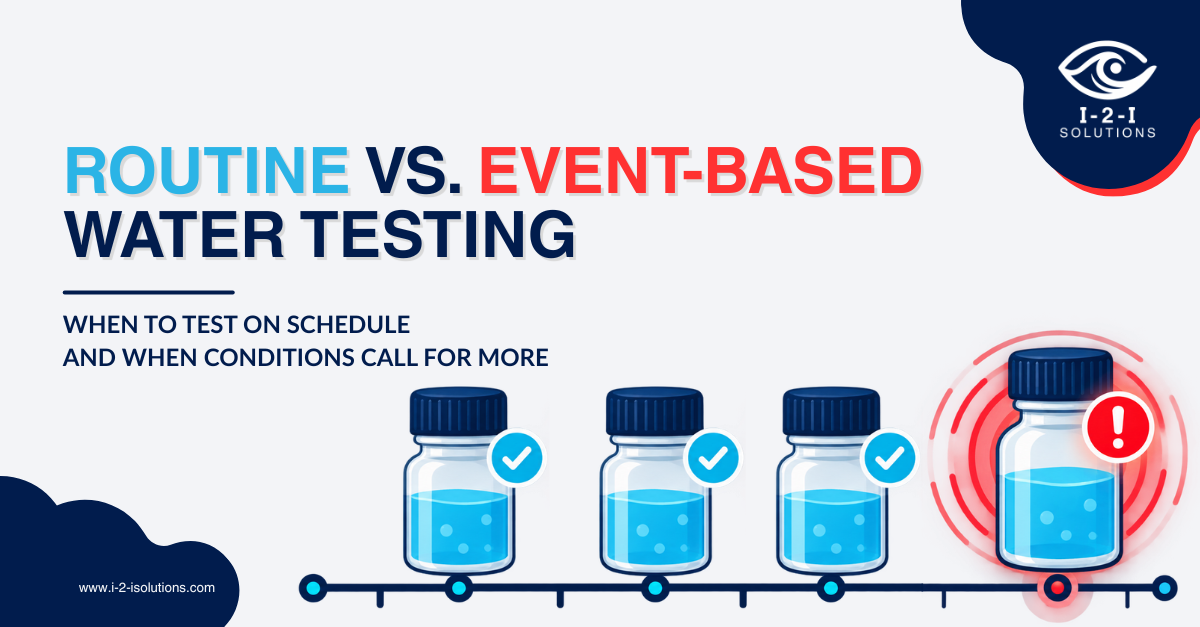
In practice, a complete strategy usually includes two complementary approaches: routine testing and event-based testing.
What Is Routine Water Testing?
Routine testing is planned testing performed on an established schedule, rather than in response to a known case or immediate incident. Its purpose is to provide information about the water system under normal operating conditions.
For Legionella, the Centers for Disease Control and Prevention (CDC) identifies routine environmental sampling as one way to validate whether a water management program is working. CDC states that inpatient healthcare facilities should conduct routine Legionella testing because they serve vulnerable populations. However, the agency does not prescribe one universal interval. The facility’s water management program team determines the frequency, locations, and methods based on the building and its risks.
Routine testing can help a facility establish a baseline, compare results over time, identify emerging patterns, and evaluate whether control measures remain effective. Depending on the program, this may include operational monitoring, such as temperature and disinfectant residual measurements, alongside microbiological testing for Legionella or other organisms relevant to the facility.
The value of routine testing comes from consistency and context. A single laboratory result provides information about a particular sample collected at a particular time. A series of well-documented results, connected to system conditions and operational data, can reveal whether conditions are stable, improving, or moving away from control.
What Is Event-Based Water Testing?
Event-based testing is performed when a specific change or incident creates a reason to reassess water quality. These events may alter temperature, disinfectant residual, water age, flow, pressure, or other conditions that influence microbial growth and distribution.
Healthcare facilities may consider additional assessment or testing after:
- Construction, renovation, or plumbing modifications
- Water-service interruptions, pressure loss, or boil-water advisories
- Extended low occupancy, closure, or reopening
- Major maintenance or commissioning activities
- Temperature or disinfectant residual measurements outside established control limits
- Unexpected or concerning laboratory results
- Corrective action or remediation
- Changes in incoming water quality
- A suspected or confirmed healthcare-associated case of Legionnaires’ disease
- A cluster, outbreak, or public-health investigation
The appropriate response will depend on the event. A localized plumbing repair may require a targeted assessment of the affected area, while a system-wide pressure loss or suspected healthcare-associated case may require broader coordination among facilities, infection prevention, clinical teams, laboratory personnel, and public-health authorities.
Testing during a disease investigation may also differ from routine testing. The sampling locations, number of samples, collection procedures, laboratory methods, and interpretation should be selected for the purpose of the investigation rather than copied automatically from the routine sampling plan.
Routine and Event-Based Testing Answer Different Questions
Routine and event-based testing are not competing approaches. Each serves a different purpose within the facility’s broader water-management strategy.
| Routine testing | Event-based testing |
|---|---|
| Performed on a planned schedule | Initiated by a defined change, deviation, or concern |
| Establishes baselines and supports trend analysis | Evaluates the effects of a specific event |
| Helps validate ongoing control measures | Supports investigation, corrective action, or follow-up |
| Uses representative locations selected through the sampling plan | Often focuses on affected systems, zones, devices, or exposure pathways |
| Continues as part of the water management program | May involve one sampling event or several rounds of follow-up testing |
A facility that relies only on routine testing may miss the importance of changes that occur between scheduled sampling dates. A facility that tests only after disruptions or suspected cases may lack the baseline information needed to understand whether a result represents a new problem or an established pattern.
Combining both approaches provides a clearer picture of normal system performance while preserving the ability to respond when conditions change.
How Often Should Healthcare Facilities Test Their Water?
The testing schedule should be based on the facility’s risk assessment and documented within the water management program. The goal is not simply to test more often. It is to test at intervals and locations that produce useful information for managing the system.
Several factors can influence the appropriate frequency.
Patient Population
Facilities serving transplant recipients, oncology patients, older adults, or other highly susceptible populations may require a more intensive monitoring strategy. The consequences of exposure can be greater in these settings, making program validation especially important.
Water-System Design and Complexity
Large campuses, multiple buildings, storage tanks, recirculating hot-water systems, long pipe runs, low-flow areas, and multiple pressure zones can make water quality more difficult to characterize. The sampling schedule should reflect how water moves through the facility and where conditions may support stagnation or microbial growth.
Water-Use and Occupancy Patterns
Infrequently used outlets and partially occupied areas may experience increased water age. Changes in occupancy, clinical services, or building use can therefore affect both routine sampling locations and the need for event-based testing.
Performance of Control Measures
Temperature, disinfectant residual, flushing, equipment operation, and other control measures provide important information between laboratory sampling events. Repeated deviations or inconsistent performance may justify additional testing or a revision to the existing schedule.
Previous Results and Corrective Actions
Historical laboratory data can help the water management team identify trends and recurring areas of concern. Follow-up testing may also be needed after corrective action to evaluate whether control has been restored and maintained.
Applicable Requirements
Federal, state, local, accreditation, contractual, and organization-specific requirements may affect testing expectations. For example, VA healthcare facilities may be subject to VHA requirements that do not apply to non-VA facilities. The former CMS memorandum S&C 17-30 is now marked expired, but current CMS hospital interpretive guidance continues to address water-management policies, testing protocols, control measures, documentation, and corrective actions.
Taken together, these factors may lead a facility to use different testing frequencies for different buildings, systems, devices, or patient-care areas. The rationale should be documented and reviewed whenever conditions change.
Define Event Triggers Before They Occur
An effective water management program should identify the conditions that trigger additional evaluation or testing. Establishing these triggers in advance helps the team respond consistently and reduces uncertainty during a disruption.
For each trigger, the plan should clarify who needs to be notified, which systems or areas require assessment, whether immediate control measures are necessary, what type of testing may be appropriate, and how follow-up decisions will be documented.
It should also define how the team will determine whether corrective action was effective. Depending on the situation, that determination may involve operational measurements, laboratory testing, a review of system conditions, or a combination of these elements.
Testing Frequency Is Only One Part of a Strong Sampling Plan
Even a carefully selected testing interval will provide limited value if the sampling locations, methods, and documentation do not support the facility’s objectives.
Before collecting samples, the water management team should be able to explain what the testing is intended to evaluate. Sampling locations should represent the systems, control points, patient risks, and potential exposure pathways identified in the program. Collection and laboratory methods should be appropriate for the intended use of the results, and the process should remain consistent enough to support meaningful comparisons over time.
Documentation is equally important. Results should be connected to the exact sampling location, date and time of collection, collection conditions, operational measurements, laboratory method, corrective actions, and follow-up activities. This creates a traceable record that supports interpretation and program review. Review the key steps for documenting Legionella water testing in healthcare facilities.
From a Testing Calendar to a Water-Quality Strategy
The question should not be limited to, “How often should we test?” A more useful set of questions is:
- What does the facility need to learn from the testing?
- Which locations best represent the system and its risks?
- What changes should trigger additional testing?
- How will results be interpreted with operational and historical data?
- What actions will follow if the results or control measures indicate a concern?
Routine testing provides the baseline and trends needed to evaluate ongoing performance. Event-based testing helps the facility respond to disruptions, changes, and potential loss of control. Together, they create a more responsive and defensible approach to healthcare water quality.
How I-2-I Solutions Supports Healthcare Water Testing
I-2-I Solutions provides professional water sampling and accredited laboratory testing for healthcare facilities. Our team can help coordinate sampling locations, appropriate containers and procedures, chain-of-custody documentation, sample handling, delivery, and laboratory analysis so that the testing process aligns with the facility’s objectives.
Our ISO/IEC 17025-accredited laboratory provides culture-based Legionella testing, and I-2-I Solutions is a CDC ELITE laboratory. We support healthcare, government, commercial, and other facilities that need reliable laboratory data for informed water-quality decisions.
Laboratory testing is one part of a broader water-management process. Results should be evaluated by the facility’s water management team alongside system conditions, operational controls, patient risk, testing history, and applicable requirements
References
- Centers for Disease Control and Prevention. “Water Management Program Validation.” https://www.cdc.gov/control-legionella/php/wmp/validation.html
- Centers for Disease Control and Prevention. “Routine Legionella Testing in Buildings Without Cases.” https://www.cdc.gov/control-legionella/about/routine-legionella-testing-in-buildings-without-cases.html
- Centers for Disease Control and Prevention. “Steps to Develop a Water Management Program.” https://www.cdc.gov/control-legionella/php/wmp/wmp-steps.html
- Centers for Disease Control and Prevention. Developing a Water Management Program to Reduce Legionella Growth and Spread in Buildings: A Practical Guide to Industry Standards. https://www.cdc.gov/control-legionella/media/pdfs/toolkit.pdf
- Centers for Medicare & Medicaid Services. State Operations Manual, Appendix A Survey Protocol, Regulations and Interpretive Guidelines for Hospitals, updated through QSO-25-24-Hospitals. https://www.cms.gov/files/document/qso-25-24-hospitals-original-release-date-2025-09-05.pdf
- ASHRAE. “Guidance for Water System Risk Management,” including ANSI/ASHRAE Standard 188 and ASHRAE Guideline 12. https://www.ashrae.org/technical-resources/standards-and-guidelines/guidance-for-water-system-risk-management
- U.S. Department of Veterans Affairs. VHA Directive 1061(4): Prevention of Health Care-Associated Legionella Disease and Scald Injury from Water Systems. https://www.va.gov/vhapublications/ViewPublication.asp?pub_ID=9181